Conversational AI agents have quickly moved from futuristic ideas to everyday business tools. They answer questions, guide customers, support employees, and automate routine tasks around the clock. When implemented thoughtfully, they can dramatically improve customer experience, enhance AI for call center efficiency, reduce operational costs, and unlock new revenue opportunities.
This guide breaks down conversational AI agents in clear, practical terms. You will learn what they are, how they work, where they deliver the most value, and how to get started with a strategy that actually moves the needle for your organization. You can also learn more about the benefits of AI Call Center to see the full potential of these technologies.
Organizations can achieve better results by using cloud systems to enhance AI-driven customer support. These setups allow conversational AI agents to handle multiple queries simultaneously, reducing wait times and improving overall satisfaction. Additionally, applying supercomputing resources to accelerate AI performance ensures that data processing and response generation remain fast and reliable, even during high-volume interactions.
Marketing strategies gain efficiency by leveraging AI-powered tools to manage customer interactions. These tools help businesses tailor messages, monitor engagement trends, and maintain consistent communication across all channels. Additionally, integrating AI-driven automation to improve overall marketing campaign performance allows teams to focus on strategy and creativity while ensuring accurate targeting and timely execution.
Operational and financial management benefits when leveraging intelligent systems to improve financial planning and business operations. Conversational AI agents help monitor performance, predict trends, and allocate resources efficiently, ensuring smoother workflows and higher productivity. Combining these solutions with scalable technology and automation empowers companies to deliver faster, more accurate responses while keeping the customer experience at the forefront.
By integrating conversational AI agents with scalable infrastructure, automated marketing strategies, and smart operational management, organizations can improve response times, gain actionable insights, and strengthen customer relationships. These solutions make everyday interactions more efficient and meaningful, all while maintaining the human touch that keeps customers engaged.
Top Contact Center Solutions for Businesses Using Conversational AI Agents
Choosing the right contact center solution is crucial for improving customer experience, reducing response times, and leveraging AI-driven automation. Here’s a list of the top providers that can help businesses implement conversational AI agents efficiently.
1. Bright Pattern

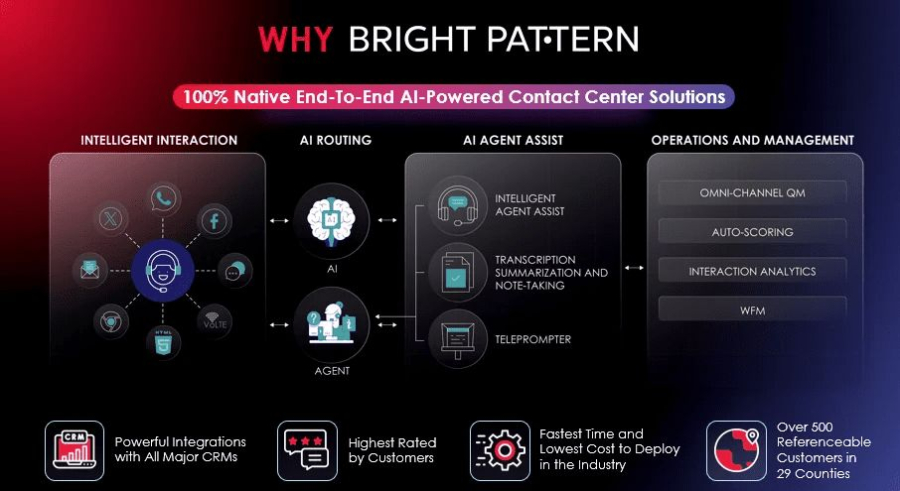
Bright Pattern is a leading provider of AI contact center solutions designed to enhance customer interactions through conversational AI agents. Their platform offers a seamless omnichannel experience, integrating voice, chat, email, and messaging apps into a single interface. Businesses can scale quickly, automate routine tasks, and provide more personalized service.
Key features include:
- Omnichannel routing for consistent customer experience
- AI-driven chatbots to automate FAQs and routine inquiries
- Advanced reporting and analytics to improve agent performance
- Integration with CRM, helpdesk, and business software
- Real-time monitoring to optimize contact center operations
Bright Pattern’s solution is designed to help organizations reduce operational costs, increase customer satisfaction, and leverage AI capabilities for smarter service delivery.
2. Genesys Cloud CX
Genesys Cloud CX offers a robust platform for AI-enhanced customer interactions. It focuses on omnichannel communication, workforce engagement, and real-time analytics to improve operational efficiency.
3. Five9
Five9 provides cloud-based contact center solutions that integrate AI-driven virtual agents, predictive dialing, and workforce optimization to enhance call handling and service quality.
4. NICE inContact
NICE inContact CXone delivers AI-powered customer service solutions with predictive analytics, intelligent routing, and omnichannel engagement to streamline customer interactions.
5. RingCentral Contact Center
RingCentral offers cloud contact center software with conversational AI agents that help automate common inquiries, route calls efficiently, and provide actionable insights to supervisors.
6. Talkdesk
Talkdesk provides a cloud-based platform that incorporates AI to improve customer service, including automated workflows, smart routing, and analytics to optimize agent performance.
7. 8x8 Contact Center
8x8 Contact Center solutions combine AI-driven automation with omnichannel communication to deliver faster response times, reduce workload for agents, and enhance customer satisfaction.
8. Avaya OneCloud CCaaS
Avaya OneCloud CCaaS leverages AI to support agent assistance, analytics, and intelligent routing, helping organizations improve the quality and speed of their customer interactions.
9. Cisco Webex Contact Center
Cisco Webex Contact Center integrates AI-powered conversational agents to manage calls, chats, and emails efficiently while providing actionable insights for continuous improvement.
10. Amazon Connect
Amazon Connect provides a cloud contact center service that uses AI to offer conversational experiences, including chatbots, voice assistants, and automated workflows to improve service efficiency.
What Are Conversational AI Agents?
Aconversational AI agentis a software application that uses artificial intelligence to understand and respond to human language in a natural, interactive way. You interact with it using text, voice, or both, and it responds with relevant, context-aware answers or actions.
They show up in many forms, including:
- Chatbotson websites, mobile apps, and messaging platforms.
- Voice assistantsembedded in devices, mobile apps, or phone systems.
- In‑app helpersthat guide users through complex workflows or products.
- Internal agentsthat assist employees with HR, IT, or knowledge queries.
Unlike simple scripted bots that follow rigid decision trees, modern conversational AI agents use natural language processing and machine learning to handle more flexible, human-like conversations.
How Conversational AI Agents Work (Without the Jargon)
Behind the friendly chat interface, a conversational AI agent goes through several steps to understand and respond to a user.
1. Input Understanding
First, the agent needs to understand what the user said or typed.
- Speech recognition(for voice): turns spoken audio into text.
- Natural Language Understanding (NLU): analyzes the text to figure out the user’s intent and extract key information (like dates, product names, or locations).
Example: If a user says, “I want to change my delivery address for next week,” the agent identifies the intent asupdate delivery addressand pulls out the time referencenext weekas a parameter it needs to handle.
2. Decision and Action
Once the agent understands the intent, it decides what to do:
- Look up answers in aknowledge base.
- Trigger abusiness workflow(for example, update an order, reset a password, open a ticket).
- Ask follow-up questions to clarify missing details.
Here, the agent may interact with APIs, databases, or back-end systems to complete the requested task.
3. Response Generation
After deciding on the next action, the agent creates a response:
- NLG (Natural Language Generation)forms a clear, user-friendly sentence or message.
- The response is then delivered as text or converted to speech for voice interfaces.
In more advanced setups, large language models can generate responses that sound highly natural while following safety and business rules.
4. Learning and Optimization
Over time, conversational AI agents can improve through feedback and data:
- They learn fromcommon questionsthey could not answer.
- They refine their models based onsuccessful vs. failed interactions.
- They adapt to new product names, campaign terms, and seasonal topics.
With regular optimization, the agent becomes more accurate, more helpful, and more aligned with how your customers actually speak.
Key Benefits of Conversational AI Agents
When implemented well, conversational AI agents deliver measurable benefits for both customers and internal teams.
1. 24/7 Availability
Conversational agents never sleep. They can:
- Answer questions at any hour, not just during office times.
- Support customers in different time zones without extra staffing.
- Handle spikes in demand during campaigns, product launches, or seasonal peaks.
This always-on support improves customer experience and reduces frustration from long waits or limited business hours.
2. Faster Responses and Shorter Queues
Customers expect quick answers. Conversational AI agents respond in seconds, not minutes. They can:
- Handle high volumes of routine questions in parallel.
- Deflect simple tickets away from human agents.
- Shorten average wait times for those who do need human assistance.
The result is a smoother support experience and a more efficient service operation.
3. Cost Efficiency and Scalability
Because AI agents can manage many conversations simultaneously, they scale more easily than traditional teams.
- Lower cost per interactionfor simple, repetitive queries.
- Reduced pressure on hiringduring growth phases or busy seasons.
- Better resource allocation, so human agents focus on high-value or complex work.
This does not replace people; it amplifies them, allowing your team to do deeper, more meaningful work rather than repeatedly answering the same basic questions.
4. Consistent, On‑Brand Answers
Human agents can vary in how they explain policies, products, or processes. Conversational AI agents, on the other hand, deliver:
- Standardized explanationsbased on verified content.
- Consistent tone of voicethat matches your brand guidelines.
- Compliance-friendly responsesaligned with regulatory or legal requirements.
This consistency is especially valuable in regulated industries, multi-location organizations, and global brands.
5. Rich Customer Insights
Every conversation with an AI agent generates data. When analyzed, this data can reveal:
- Common pain points or confusing parts of your product experience.
- Frequent pre-purchase questions that influence buying decisions.
- Emerging issues before they become widespread complaints.
These insights help product, marketing, sales, and service teams make better decisions grounded in real user behavior.
6. Better Employee Experience
Conversational AI is not only for customers. Internal agents can support employees by:
- Answering HR questions about benefits, policies, and time off.
- Resolving common IT requests or guiding basic troubleshooting.
- Helping new hires find information quickly during onboarding.
This reduces internal friction, speeds up everyday tasks, and lets people focus on higher-impact work.
Common Use Cases for Conversational AI Agents
Conversational AI agents can be tailored to many functions and industries. Below are high-impact, widely adopted use cases.
Customer Support and Service
- Answer frequently asked questions about orders, accounts, or policies.
- Provide step-by-step troubleshooting for common issues.
- Collect information before routing complex cases to human agents.
- Offer self-service options for tracking, cancellations, or updates.
Sales and Pre‑Purchase Assistance
- Recommend products or plans based on user needs and preferences.
- Clarify product features, pricing, and availability.
- Schedule demos or consultations automatically.
- Qualify leads by asking structured questions and scoring responses.
Marketing and Engagement
- Welcome new visitors and guide them to relevant content or offers.
- Run interactive experiences such as quizzes or guided journeys.
- Re-engage returning visitors with personalized suggestions.
HR, IT, and Internal Support
- Answer “How do I…” questions about internal tools and processes.
- Walk employees through standard procedures (for example, expense submissions or security steps).
- Help staff navigate knowledge bases, policies, and documentation.
Industry-Specific Examples
- Retail and eCommerce: order tracking, returns, personalized recommendations.
- Banking and Finance: balance and transaction questions, appointment scheduling, product guidance.
- Healthcare: appointment requests, pre-visit questionnaires, symptom triage guidance (within defined limits).
- Travel and Hospitality: booking assistance, itinerary changes, check-in details, local information.
Types of Conversational AI Agents
Not all agents are created equal. Understanding the main types helps you choose the right fit for your goals.
|
Type |
How It Works |
Best For |
|
Rule-based chatbot |
Follows predefined decision trees and keywords. |
Very simple, predictable interactions and FAQs. |
|
NLU-powered agent |
Understands intents and entities using machine learning. |
More flexible support, sales, and internal help use cases. |
|
Generative AI agent |
Uses large language models to generate natural responses. |
Rich, open-ended conversations and complex information retrieval. |
|
Hybrid agent |
Combines rules, NLU, and generative models with business logic. |
Enterprise-grade deployments with safety, control, and scale. |
Many modern solutions are hybrid in practice, blending predictability and control with the flexibility of advanced language models.
Designing a High-Performing Conversational AI Agent
Successful conversational AI is less about technology alone and more about thoughtful design. Here are core principles to guide your approach.
1. Start with Clear, Focused Goals
Define what success looks like before you build anything. For example:
- Reduce support ticket volume in a specific category.
- Increase the number of qualified leads passed to sales.
- Improve self-service rates for common account tasks.
- Accelerate internal response time for HR or IT questions.
Clear goals shape how you design flows, what content you prioritize, and how you measure impact.
2. Know Your Users and Their Language
Effective agents reflect how real people speak, not how internal teams talk. To align with users:
- Review real chat logs, emails, or call transcripts to see common phrasing.
- Note the most frequent questions and where confusion appears.
- Capture product nicknames, abbreviations, and slang customers use.
This user-centric research ensures your agent actually understands and responds to real-world language, not idealized scripts.
3. Design Clear, Friendly Conversation Flows
Even advanced AI benefits from thoughtful conversation design:
- Greet users with a short, friendly introduction and clear capabilities.
- Offer a few high-value options to start (for example, track order, get support, explore pricing).
- Use concise, jargon-free language that respects users’ time.
- Ask one question at a time when collecting information.
Think of it as designing a helpful guide, not just a technical interface.
4. Balance Automation with Human Escalation
No matter how advanced your agent is, there will always be questions that require a human touch. Strong experiences include:
- Clear pathways to hand off to human agents when needed.
- Context transfer, so humans can see the chat history and avoid repetition.
- Transparent messaging, such as “I am going to connect you to a teammate now.”
This balance reassures users that they will not get stuck and builds trust in the AI experience.
5. Keep Knowledge Accurate and Up to Date
Your agent is only as good as the information it has access to. To keep it effective:
- Maintain a central knowledge base or content library.
- Update answers when products, policies, or pricing change.
- Review conversations regularly to find gaps and improve coverage.
Ongoing content management turns your agent into a living, evolving expert rather than a static script.
6. Prioritize Privacy, Security, and Trust
Users share sensitive details during conversations. Protecting that data is essential:
- Collect only the information you genuinely need to solve the request.
- Follow relevant data protection laws and organizational policies.
- Be transparent about what the agent can and cannot do.
Clear boundaries and responsible design build long-term trust in your AI solutions.
Measuring the Impact of Conversational AI Agents
To demonstrate value and continuously refine your agent, track a blend of performance and experience metrics.
Core Performance Metrics
- Containment rate: percentage of conversations fully handled by the agent without needing human intervention.
- Resolution rate: percentage of issues successfully solved in the first interaction.
- Average handling time: time to resolve user requests compared with traditional channels.
- Ticket deflection: reduction in volume reaching email, phone, or live chat teams.
Experience and Quality Metrics
- Customer satisfaction (CSAT): post-conversation ratings or quick thumbs-up feedback.
- Net Promoter Score (NPS)impact: changes in loyalty after introducing AI support options.
- User effort: how easy it is for users to get things done on their own.
- Escalation quality: how smoothly complex cases move from AI to human agents.
By combining these metrics, you get a full picture of how your conversational AI is supporting both business performance and user satisfaction.
Realistic Success Patterns You Can Aim For
Organizations that roll out conversational AI agents successfully tend to follow similar patterns. While specific results vary, common positive outcomes include:
- Significant self-service adoption, where a large share of simple queries are resolved without human involvement.
- Noticeable reduction in response times, especially during busy periods.
- Improved experience scoresfor customers who prefer instant chat over waiting on hold.
- Higher productivityfor support teams who can now focus on complex, relationship-building work.
- New revenue opportunitiesthrough proactive recommendations, upsell suggestions, or smoother buying journeys.
The most persuasive success stories often highlight how AI agents complement human expertise instead of trying to replace it. When people and AI work together, the end result is usually faster service, better answers, and a more enjoyable experience on both sides of the conversation.
Practical Steps to Get Started
If you are considering conversational AI agents for your organization, you do not need to transform everything at once. Start small, learn quickly, and expand based on results.
Step 1: Choose One High-Impact Use Case
Pick a focused area where AI can clearly help. Ideal starting points include:
- A cluster of repetitive support questions.
- A bottleneck in the sales or onboarding process.
- An internal function where employees frequently struggle to find answers.
This gives you a manageable scope and clear metrics for success.
Step 2: Map the Conversation Journey
Outline the typical paths users might take. For each, note:
- The initial question or problem.
- The information the agent needs to collect.
- The systems the agent must access (for example, CRM, ticketing, or order systems).
- The ideal outcome from the user’s perspective.
Use this map to design friendly, step-by-step interactions.
Step 3: Prepare Content and Knowledge
Gather and refine the information your agent will rely on:
- Clear, concise answers to common questions.
- Standardized policy explanations.
- Approved messages for sensitive topics.
Well-structured content is crucial for reliable, accurate responses.
Step 4: Implement, Test, and Train
Once your initial version is live, spend time:
- Testing with real users or internal teams before broad rollout.
- Reviewing conversation logs to identify misunderstandings.
- Adjusting intents, training data, and responses to boost accuracy.
Early feedback cycles are where you shape a good agent into a great one.
Step 5: Launch, Measure, and Iterate
After launch, regularly review performance and user feedback.
- Track your defined metrics over time.
- Add new intents and flows based on user demand.
- Refine escalation rules so users always feel supported.
Continuous improvement keeps your conversational AI agent aligned with your evolving products, services, and customer expectations.
The Future of Conversational AI Agents
Conversational AI is moving rapidly from simple question-answering tools toward more capable digital teammates. Looking ahead, you can expect:
- More natural dialogue, with agents remembering context across channels and sessions.
- Deeper system integration, letting agents take complex actions rather than just sharing information.
- Personalized experiencesthat adapt to each user’s history, preferences, and goals.
- Stronger governance and safety, ensuring AI aligns with ethical standards and organizational policies.
For businesses, this means a growing opportunity to deliver exceptional, scalable experiences that feel increasingly human, while staying efficient and consistent.
Bringing It All Together
Conversational AI agents are no longer experimental extras; they are becoming central to how modern organizations communicate, support, and sell. When you approach them with clear goals, user-focused design, and a commitment to continuous improvement, they can:
- Delight customers with fast, helpful answers.
- Empower employees with instant access to knowledge.
- Streamline operations and free teams to focus on high-value work.
- Reveal insights that guide smarter, more customer-centric decisions.
By starting with a focused use case and scaling thoughtfully, you can turn conversational AI agents into a powerful, long-term advantage for your organization.
